Saudi defence sector M&A is increasingly shaped by a simple direction: move from buying systems to building capabilities. At the World Defense Show, KPMG’s five-day program examined how defense strategies are evolving from procurement-led models to integrated capability development anchored in human capital, localization, and digital readiness. Sessions discussed alignment between technology and real operational needs, and the role of localization and partnerships in building a sovereign, scalable defense ecosystem. This context matters for dealmaking. When the priority becomes capability development, transactions and partnerships tend to focus on transfer of knowledge, production readiness, and supply chain depth rather than only product delivery.
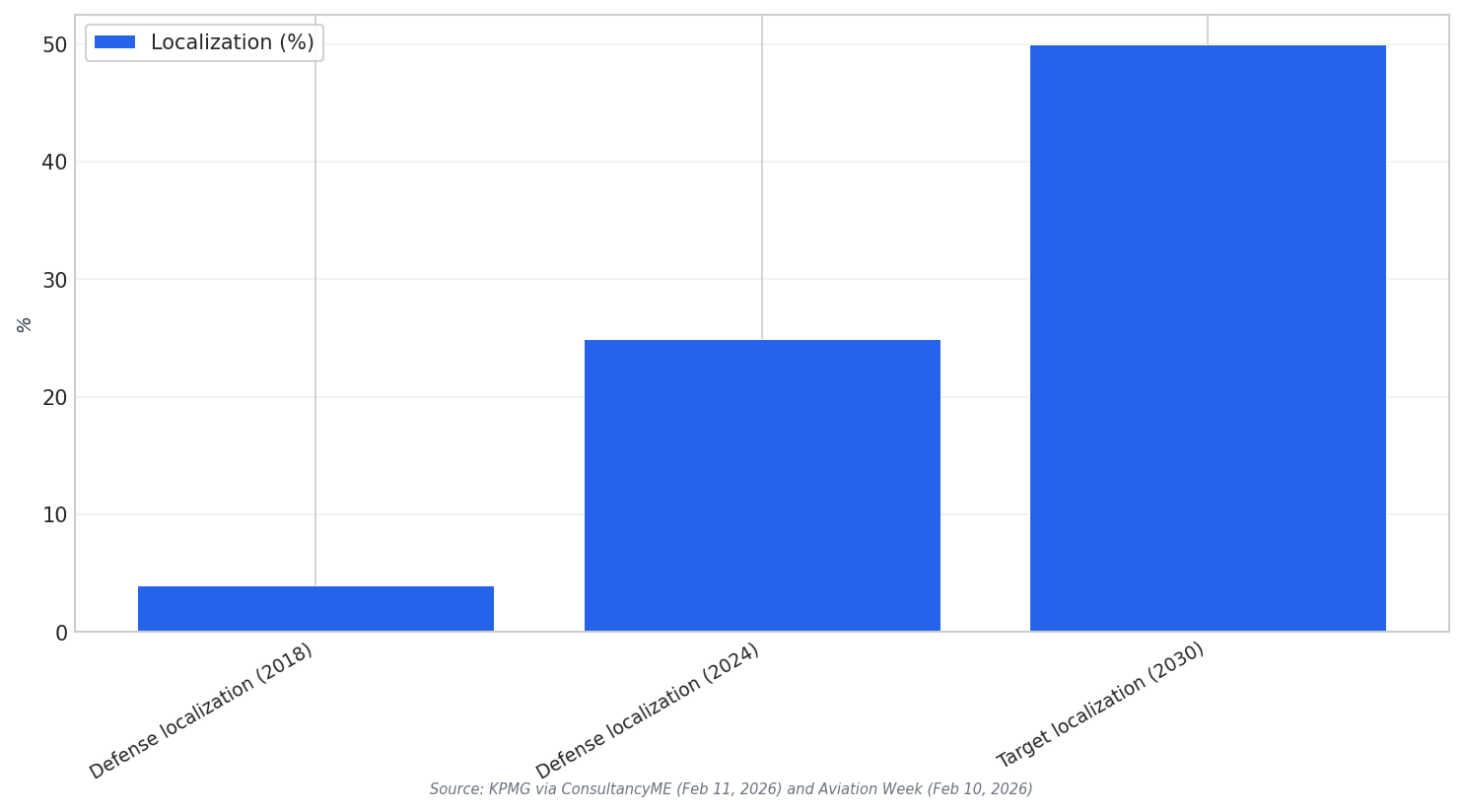
The localization numbers show why deal activity is linked to industrial outcomes. KPMG reported that defense localization in Saudi Arabia increased from around 4% in 2018 to 24.9% in 2024, with a target of 50% localization by 2030. Reporting from the World Defense Show also cited close to 25% localization by the end of 2024 and reiterated the same 50% target by 2030. KPMG also noted that local content across the defense sector reached 40.7%, up from 38.4% in 2023. These figures frame what “success” looks like for Saudi defence sector M&A: deals that expand local production, deepen industrial participation, and accelerate technology adoption.
What Localization-Driven Dealmaking Looks Like in Practice
In this environment, Saudi Arabia has signaled it is not seeking a transactional relationship with foreign defense companies. Instead, it wants strategic partnerships that lead to meaningful capability development and transfer of knowledge, with “win-win arrangements where innovation can take place across countries,” according to remarks reported from the World Defense Show. That approach aligns with how localization deals can be structured: partnering for manufacturing ecosystems, integrating next-generation technologies into defense capabilities, and building industrial foundations that can support export ambitions. KPMG’s conference sessions also emphasized positioning Saudi Arabia as a world-class manufacturing hub and trusted exporter, while linking collaboration to talent development and operational readiness.
Supply chain resilience and industrial depth are repeatedly connected to localization, which is where M&A logic often becomes strongest. At the World Defense Show, the governor for the General Authority for Military Industries linked localization to building industrial depth, creating more resilient supply chains, and bolstering national readiness. He also pointed to greater reliance on small- and medium-sized companies as a “backbone for long-term national readiness.” For Saudi defence sector M&A, this frames a pipeline of potential targets and partners: firms that can scale production, add specialized manufacturing capability, or strengthen the ecosystem integration that KPMG highlighted as a key theme across its published white papers.
Deal narratives also sit inside a broader industrial push that supports advanced manufacturing and technology transfer. Saudi officials have used global platforms to review investment opportunities and incentives across advanced manufacturing and marine industries, and a cooperation agreement was signed between the National Industrial Development Center and Fincantieri to strengthen partnerships in marine industries. While not framed as a defense acquisition, it demonstrates the same localization playbook: partnerships designed to transfer the latest technologies to the Kingdom. For companies evaluating Saudi defence sector M&A, the takeaway is clear: fit with localization, technology adoption, workforce development, and ecosystem readiness is the core value driver.
What is driving Saudi defence sector M&A right now?
How much has defense localization increased in Saudi Arabia?
What is the localization target connected to Vision 2030?
What does KPMG report about local content in the defense sector?
Why do partnerships matter for Saudi defence sector M&A?
Talk to us for your needs in:
-
Due Diligence and Valuation Services
-
M&A Strategy and Advisory
-
Post-Merger Integration Management
-
Regulatory and Compliance Advisory
-
Market Entry and Expansion Consulting
-
Investment and Financial Analysis
-
In-Depth Market Survey for M&A
-
Market Intelligence and Insights in M&A
-
Feasibility Study and Assessment in M&A
-
Saudi M&A Benchmarking