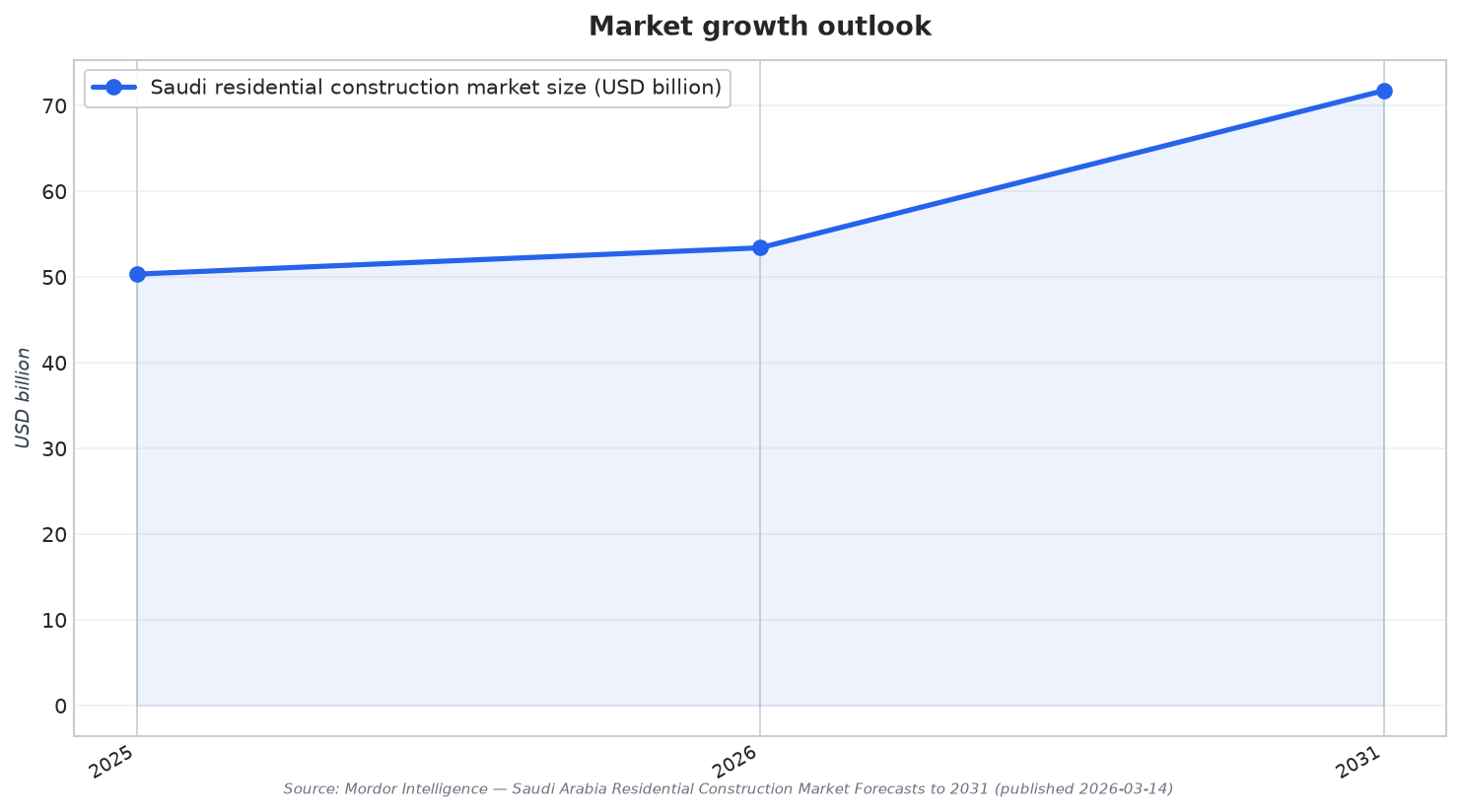
Saudi Arabia’s residential pipeline is still being pulled forward by national targets, even as delivery frictions raise the bar for developers. Mordor Intelligence projects the Saudi residential construction market at USD 50.34 billion in 2025 and USD 53.41 billion in 2026, reaching USD 71.75 billion by 2031 (6.09% CAGR from 2026 to 2031). That growth sits alongside operational constraints the industry keeps flagging. The same outlook points to input-cost inflation and slow utility hookups as near-term headwinds, while contractor pipelines are “filling quickly” as Public Investment Fund (PIF) subsidiaries pre-book capacity. In that kind of market, execution capability becomes a differentiator, and weaker balance sheets can be exposed faster than the headline demand suggests.
Housing policy keeps pressure on the supply side. Mordor Intelligence reports homeownership at 65.4% in 2024, with a stated goal of 70% by 2030. It also notes annual housing demand around 300,000 units, a target that is pushing developers toward off-site construction to avoid site-capacity bottlenecks. At the same time, Etmam’s digital permitting is described as shortening development cycles and spurring fresh launches. The mix of faster cycle times and tighter capacity can reward scaled players that can secure land, utilities, and contractors early, while smaller firms face rising coordination risk and less room for delays.
Why Scale Is Starting to Matter More in Homebuilding
Market structure data also hints at where competitive advantages concentrate. Apartments and condominiums led with a 68.7% share of Saudi residential construction in 2025, while new-build schemes captured 84.5%. Conventional on-site work still represented 87.1% in 2025, but modern modular systems are projected to grow at a 6.55% CAGR over 2026–2031. Private capital accounted for 70.1% of 2025 spending, yet public-sector programs financed by REDF and PIF are set to rise at a 6.31% CAGR to 2031. Those shifts favor developers that can standardize product, integrate procurement, and access institutional funding—conditions that often precede Saudi residential developer consolidation rather than a long tail of fragmented builders.
The gravitational pull of mega-project ecosystems adds another pressure point. MarkWide Research describes government infrastructure agencies as displacing private residential developers as the dominant procurement channel as Vision 2030 megaprojects reshape procurement priorities. IMARC also warns of “market concentration risks from mega-project resource allocation,” noting that large-scale government developments can crowd out private developers lacking comparable land pipelines and utility access. In October 2025, IMARC reports NEOM secured contracts worth USD 24 billion, and it cites PIF assets under management at USD 913 billion in 2024. As capital and contractor attention cluster around giga-project delivery, traditional homebuilders may need partnerships, acquisitions, or platform mergers to compete for scarce resources.
Large developers are already anchoring multi-city pipelines, which can accelerate a shake-out among smaller peers. Mordor Intelligence notes NHC oversees 134,000 units across 17 cities under joint-venture terms designed to reduce state outlays while speeding delivery. It adds that ROSHN’s 20 km² Riyadh community will house more than 30,000 families when complete; in January 2026, ROSHN awarded SAR 1.5 billion (USD 400 million) of Phase 4–5 contracts and secured SAR 2.1 billion (USD 560 million) of new land. With Riyadh commanding 41.3% of Saudi residential construction market size in 2025, the ability to win land, utilities, and capacity in key hubs may increasingly define who survives independently—and who becomes part of the next consolidation wave.
What is pushing developers toward consolidation in Saudi Arabia’s housing market?
How large is the Saudi residential construction market in the current forecasts?
Which housing types dominate Saudi residential construction activity?
How does the Vision 2030 homeownership goal influence developer strategy?
What does Saudi residential developer consolidation mean for smaller homebuilders?
Talk to us for your needs in:
-
Due Diligence and Valuation Services
-
M&A Strategy and Advisory
-
Post-Merger Integration Management
-
Regulatory and Compliance Advisory
-
Market Entry and Expansion Consulting
-
Investment and Financial Analysis
-
In-Depth Market Survey for M&A
-
Market Intelligence and Insights in M&A
-
Feasibility Study and Assessment in M&A
-
Saudi M&A Benchmarking