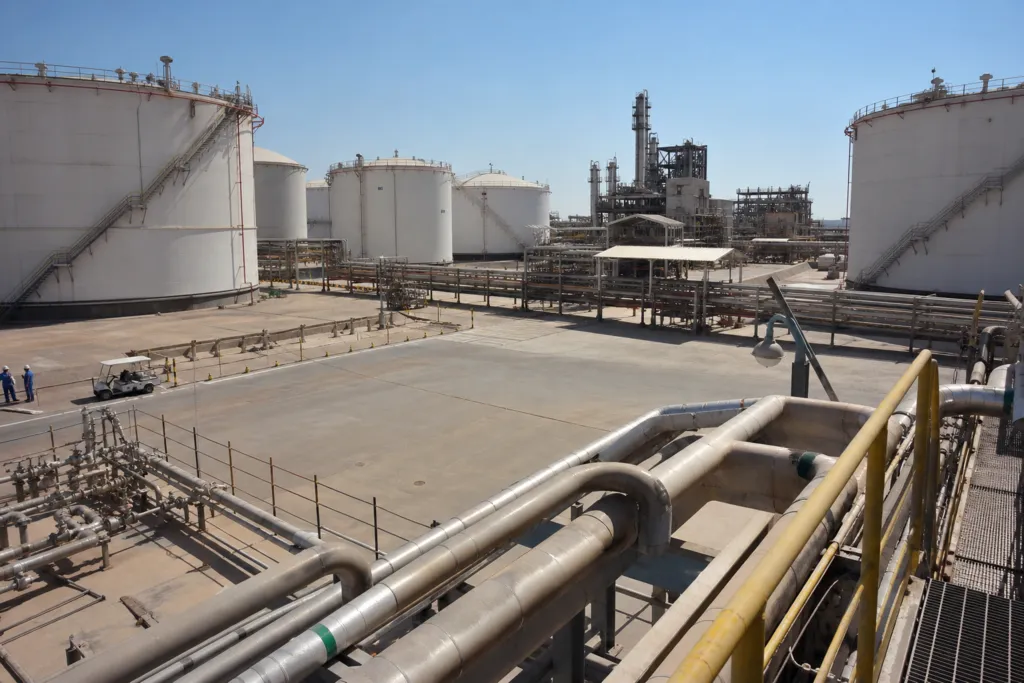
Saudi Arabia’s petrochemicals market was valued at USD 58 billion in 2025 and is projected to reach USD 83 billion by 2033, with a 4.6% CAGR over 2027–2033. National production capacity is cited at 118 million tons per year, anchored by clusters in Jubail Industrial City and Yanbu Industrial City. This scale supports export-oriented volumes and integrated supply chains, but it does not immunize every producer from margin squeeze. Mid-cap names can be exposed when input costs rise and price competition intensifies across global commodity chains. The result is a strategic backdrop in which consolidation becomes less optional and more structural.
A major local driver is the 2026 feedstock and energy repricing described as part of broader reforms. One specific headline change cited is a 35% jump in diesel prices in 2026. Company exposure varies by feedstock mix. SABIC Agri-Nutrients is described as 100% dependent on methane for its production processes. Yansab is described as having 42% ethane reliance. Sahara International Petrochemical Co (Sipchem) is also highlighted among impacted industrial names. The same source expects a drag of 1% to 3% on net income for Yansab and Sipchem, illustrating how quickly earnings can compress when cost advantages erode.
Why Consolidation Logic Strengthens When Costs Rise
Globally, the margin backdrop is also challenging. A BCG commentary describes sluggish demand growth, continued capacity expansion, and mounting geopolitical and environmental pressures, culminating in the lowest margin levels in over a decade. It also notes that global utilization rates for key commodities such as ethylene and propylene have plummeted and are forecasted to remain well below historical averages. That matters for Saudi producers because ethylene and polyethylene derivatives are described as dominant product categories in the Kingdom, and ethylene also dominates globally with 34.6% of production volume in 2024. When utilization is weak, the value of scale, integration, and portfolio discipline typically rises.
Domestic infrastructure and compliance dynamics add another layer. Midstream systems in Saudi Arabia include pipelines exceeding 20 inches in diameter and cryogenic LNG facilities designed for methane containment at minus 162 degrees Celsius. The same midstream source describes tightening environmental compliance protocols and MEE-aligned emissions standards that are forcing operators to recalculate construction specifications and material choices for sour gas service. For petrochemical producers, this matters because feedstock security and logistics reliability are tied to midstream throughput, including demand from Sadara and SABIC complexes. In a tighter cost and compliance environment, a merger can be a way to spread fixed costs and strengthen bargaining power across the value chain.
These pressures shape the narrative for Saudi petrochemical M&A 2026 without assuming that every company will pursue a deal. The consolidation playbook discussed by BCG emphasizes identifying commodity lines that can be consolidated for higher-margin applications and using transactions to access proprietary technologies that can lower R&D costs or improve manufacturing capabilities. In parallel, the 2026 repricing source argues the long-term response may include accelerating operational efficiency and technological adoption, and it also flags expectations of a wave of consolidation in industrial sectors as smaller, less efficient players struggle to maintain margins. For mid-cap petrochemical producers, merger pressure can therefore be less about growth for its own sake and more about defending competitiveness under new cost realities.
What is driving merger pressure for Saudi mid-cap petrochemical producers?
Which 2026 change is explicitly cited as impacting industrial costs in Saudi Arabia?
How exposed are Yansab and Sipchem to the 2026 feedstock changes in the sources?
How does the global market context reinforce Saudi consolidation discussions?
How should investors think about Saudi petrochemical M&A in 2026 based on these signals?
Talk to us for your needs in:
-
Due Diligence and Valuation Services
-
M&A Strategy and Advisory
-
Post-Merger Integration Management
-
Regulatory and Compliance Advisory
-
Market Entry and Expansion Consulting
-
Investment and Financial Analysis
-
In-Depth Market Survey for M&A
-
Market Intelligence and Insights in M&A
-
Feasibility Study and Assessment in M&A
-
Saudi M&A Benchmarking