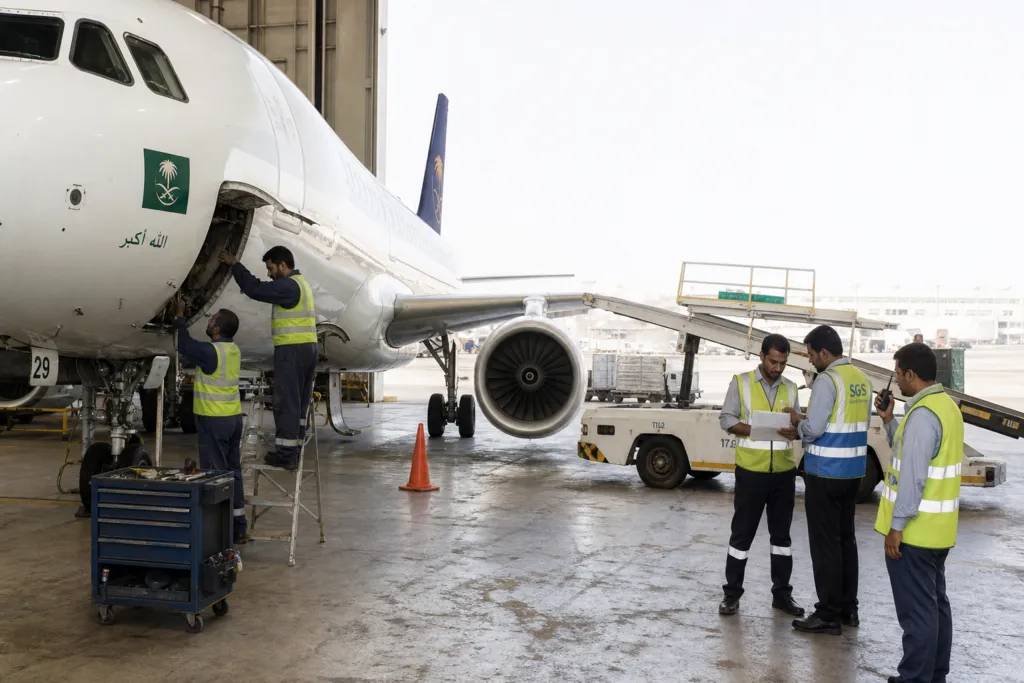
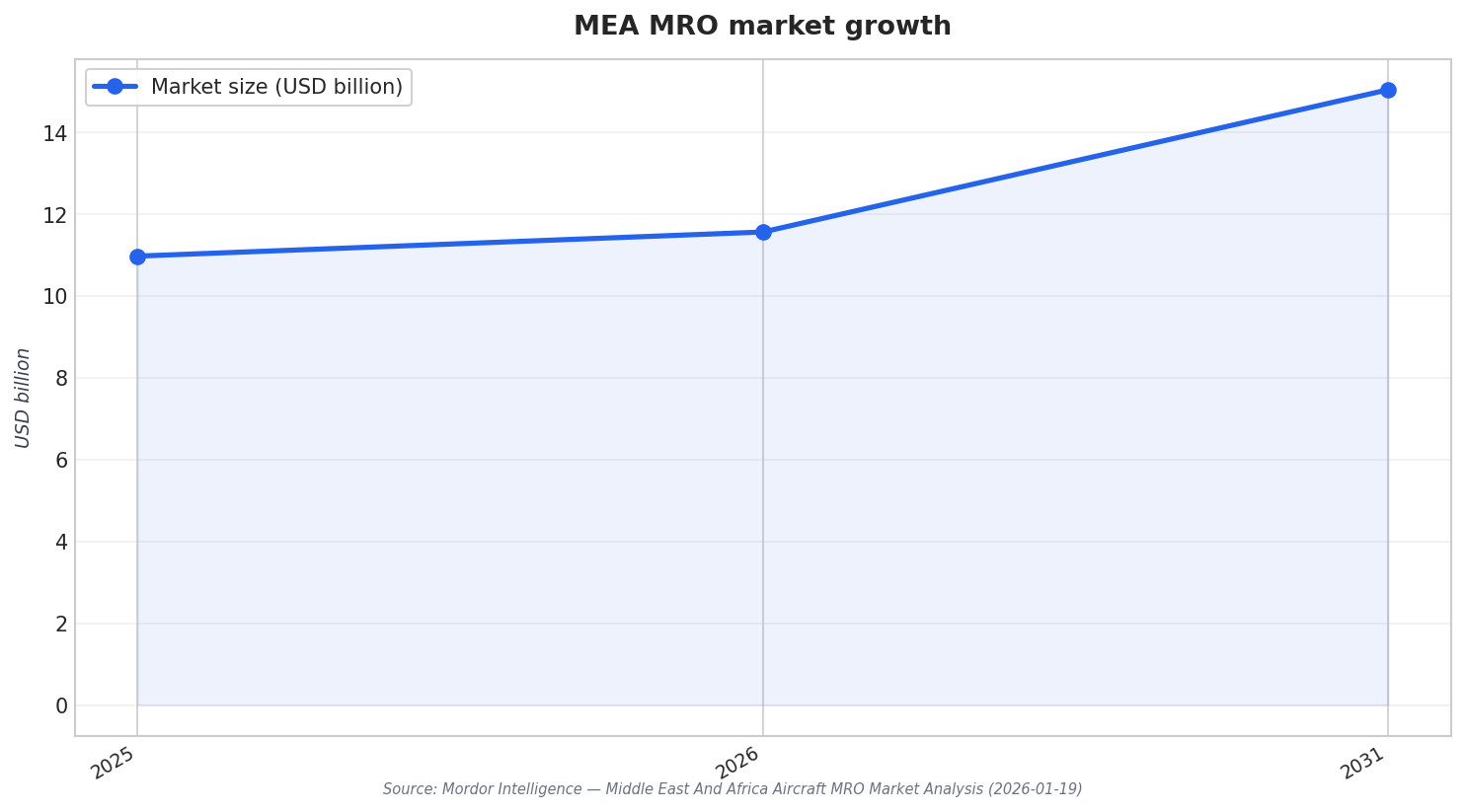
In 2026, the clearest runway for Saudi aviation M&A sits in operational businesses that airlines and airports cannot avoid: ground handling and maintenance, repair, and overhaul (MRO). On the MRO side, multiple research views point to sustained regional expansion. Mordor Intelligence values the Middle East and Africa aircraft MRO market at USD 10.98 billion in 2025 and estimates it grows from USD 11.57 billion in 2026 to USD 15.05 billion by 2031, a 5.41% CAGR for 2026–2031. Verified Market Research similarly values the MEA aircraft MRO market at USD 9.5 billion in 2024 and projects USD 13.04 billion by 2032, with a 5.06% CAGR from 2026 to 2032. For acquirers, these forecasts frame why scale, capacity, and approvals matter.
Within that regional MRO expansion, the service mix also explains deal appetite. Mordor reports that engine work led with a 37.02% share in 2025, while line maintenance is forecast to post the fastest 6.05% CAGR through 2031. The same report states commercial operations captured 64.72% of revenue in 2025, but military programs are set to log the quickest 6.92% CAGR, explicitly linked to localization targets in Saudi Arabia and the UAE. Provider structure matters too: airline in-house shops held a 46.02% share in 2025, while OEM-affiliated providers are advancing at a 6.7% CAGR by embedding predictive analytics into power-by-the-hour agreements. That combination encourages buyers to pursue capabilities that reduce turnaround risk and help win longer-term contracts.
Ground Handling and Airports: The High-Frequency Cash Flow Angle
Ground handling adds a different M&A logic: high-frequency, mandatory services that scale with traffic and airport activity. Custom Market Insights values the global airport ground handling market at $37.1 billion in 2025 and projects growth to $90.9 billion by 2034 at a CAGR of 10.5%. The same source highlights a safety-and-cost driver: IATA data cited there says aviation accidents at the gate and apron occur once every 1,000 departures, while the Flight Safety Foundation reported 27,000 ramp incidents globally (before the epidemic). It also notes that ramp handling is expected to grow fastest because these services are mandatory for all flights and aircraft types. For buyers, those points support acquisitions that standardize training, equipment, and processes across airports.
Saudi Arabia-specific signals strengthen the case for tie-ups that connect airports, airlines, and aftersales support. Knowledge Sourcing reports that government and industry leaders at the Future Aviation Forum (FAF) in Riyadh said the Kingdom pledged to invest $100 billion into its aviation sector by 2030 to upgrade air transport facilities, establish a brand-new national airline, and enable new entrants such as drones and eVTOL aircraft. While that pledge is broader than M&A, it shapes what assets become strategically valuable: maintenance capacity, approved providers, and airport services that support higher utilization. The same report notes an example of cross-border maintenance demand: FL Technics signed a deal with Saudia in August 2022 for aircraft base repair at the Kaunas hangar for Airbus A321 and A320 aircraft.
Put together, 2026 dealmaking in the Kingdom is likely to prioritize businesses that shorten downtime and keep flights moving. Mordor flags shortages of licensed technicians and parts-logistics bottlenecks that lengthen turnaround cycles and inflate aircraft-on-ground costs, which can push operators to stockpile rotables and negotiate pre-positioned inventory clauses. In practical terms, this favors acquisitions that combine line maintenance growth with engine and component depth, or pair airport ground handling scale with tighter safety discipline. The result is a more operational form of Saudi aviation M&A: less about headlines, more about owning the chokepoints that determine dispatch reliability and airport performance.
What parts of aviation are most likely to attract deal interest in Saudi Arabia in 2026?
Which MRO services look most acquisition-relevant based on MEA forecasts?
How does military MRO factor into Saudi-focused deal theses?
What safety statistics are shaping the case for consolidating ground handling providers?
What is driving the broader strategic backdrop for Saudi aviation M&A in 2026?
Talk to us for your needs in:
-
Due Diligence and Valuation Services
-
M&A Strategy and Advisory
-
Post-Merger Integration Management
-
Regulatory and Compliance Advisory
-
Market Entry and Expansion Consulting
-
Investment and Financial Analysis
-
In-Depth Market Survey for M&A
-
Market Intelligence and Insights in M&A
-
Feasibility Study and Assessment in M&A
-
Saudi M&A Benchmarking