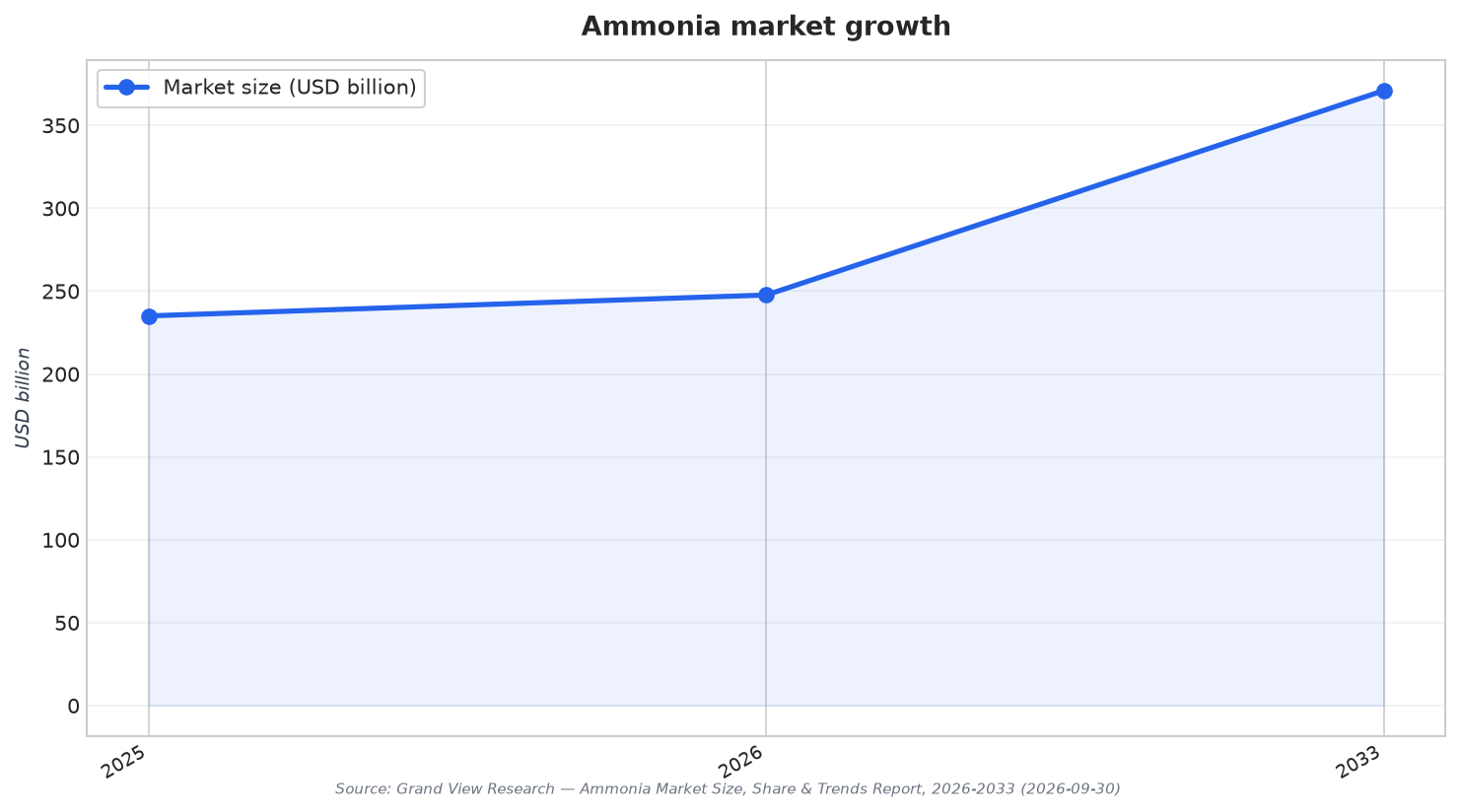
Fertiliser deal narratives are getting rewritten around feedstock exposure, downstream optionality, and where the next increment of demand will land. In that context, global ammonia market estimates are increasingly used as a valuation anchor when buyers model cash generation, reinvestment needs, and long-cycle demand. One estimate puts the global ammonia market at USD 255.03 billion in 2025 and USD 270.94 billion in 2026, rising to USD 453.30 billion by 2034 at a 6.6% CAGR (2026–2034). Another forecast values the ammonia market at $235.1 billion in 2025, projecting $247.7 billion in 2026 and $371.0 billion by 2033 at a 5.9% CAGR. These global figures are not Saudi-specific, but they shape how cross-border buyers benchmark fertiliser assets.
What makes ammonia-linked valuation work more sensitive is its dominance in end-use and the route it takes into fertiliser products. Polaris Market Research attributes a 71.2% market share to the fertilizer industry within the global ammonia market, and notes the liquid segment led with an 85.3% revenue share in 2025. That same source places Asia Pacific at a 54.1% revenue share in 2025, while forecasting the Middle East & Africa region to grow at a 5.9% CAGR on the back of low energy prices and increased spending on green/blue ammonia technology. For investors thinking about Saudi Arabia as part of a wider Middle East footprint, this is context for why strategic buyers may prioritize assets with credible operating cost positions and capex pathways tied to cleaner production.
Phosphate Growth Signals, Consolidation Cues, and What They Mean for Deals
Phosphate is the other side of the valuation equation because ammonia is a starting point for multiple fertilizer chains, including ammonium phosphate. Straits Research values the global phosphate fertilizer market at USD 76.76 billion in 2025, with a path from USD 81.12 billion in 2026 to USD 126.2 billion by 2034 at a 5.68% CAGR (2026–2034). A separate phosphate market view sizes the broader global phosphate market at USD 174.25 billion in 2023 and projects USD 246.30 billion by 2032 at a 3.92% CAGR (2024–2032). That same phosphate source explicitly flags consolidation through mergers and acquisitions, and gives one example: in December 2024, Infracon Construction, Inc. announced the acquisition of Ontario, Inc., owner of the former Agrium Phosphate Mine in Kapuskasing, Ontario, plus a processing plant in Matheson, Ontario, and other mineral properties in Ontario.
Deal appetite is also influenced by portfolio reviews and partnership language from established operators, because it signals where assets might come to market and what structures could be acceptable. Straits Research notes that in November 2025, Nutrien initiated a strategic review of its phosphate fertilizer business, evaluating partnership opportunities, operational restructuring, and potential asset optimization to strengthen its fertilizer portfolio. For Saudi fertilizer sector M&A watchers, global precedents like these matter because they normalize joint ventures, carve-outs, or targeted optimization as viable routes, even when local drivers differ. On the ammonia side, competitive set framing also affects perceived scarcity value: Grand View Research lists players such as SABIC, Qatar Fertiliser Company, Yara International, CF Industries, and Nutrien among key participants in the ammonia market.
Putting the pieces together, valuation assumptions now hinge on how buyers triangulate across multiple market outlooks, not on any single headline figure. Some forecasts emphasize scale, such as Polaris’s USD 453.30 billion global ammonia market estimate by 2034, while another public note projects ammonia market valuation to reach beyond USD 365 billion by 2032. Meanwhile, the regional split and growth rates provide a way to stress-test expansion plans: Asia Pacific’s 54.1% revenue share in 2025 speaks to demand gravity, while the Middle East & Africa 5.9% CAGR view speaks to growth narratives tied to energy economics and green/blue ammonia investment. For deal teams, these are the inputs that shape downside protection, synergy claims, and the premium paid for resilient fertiliser cash flows.
What do the latest global ammonia market estimates imply for fertiliser asset valuations?
How important is fertiliser demand within the ammonia market in these sources?
What regional signals matter when evaluating Middle East-linked ammonia strategies?
What evidence is there that phosphate markets are seeing consolidation activity?
How is Saudi Arabia’s fertilizer sector M&A discussion shaped by global precedents in these reports?
Talk to us for your needs in:
-
Due Diligence and Valuation Services
-
M&A Strategy and Advisory
-
Post-Merger Integration Management
-
Regulatory and Compliance Advisory
-
Market Entry and Expansion Consulting
-
Investment and Financial Analysis
-
In-Depth Market Survey for M&A
-
Market Intelligence and Insights in M&A
-
Feasibility Study and Assessment in M&A
-
Saudi M&A Benchmarking