

Issues
A diversified investment group with exposure to multiple sectors across the region wanted to benchmark its M&A practices, deal performance, and governance structures against best practice in the Saudi market. The group had already executed several transactions in Saudi Arabia across manufacturing, services, and consumer sectors, but had never systematically evaluated how its approach compared to other active acquirers. They engaged our team to conduct a Saudi M&A benchmarking exercise, aiming to identify gaps, strengths, and improvement opportunities across the full deal lifecycle.
Solution
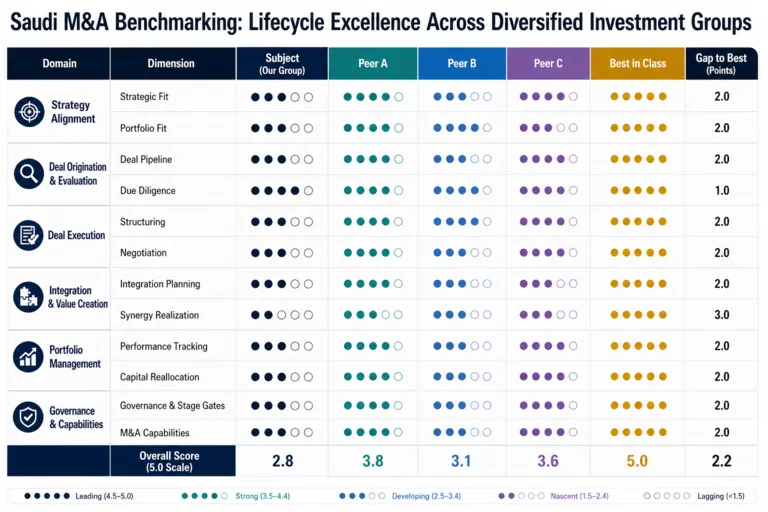
We conducted a comprehensive M&A benchmarking study anchored in the Saudi context. The solution analyzed the client’s historical deals and compared them against market practices and best-in-class benchmarks across key dimensions: strategy alignment, pipeline management, due diligence depth, valuation discipline, integration models, and post-deal performance tracking. We combined qualitative insights from interviews with external stakeholders and internal teams with quantitative metrics on deal timing, outcomes, and value realization. The output was a detailed benchmarking report and transformation roadmap to enhance the client’s M&A capabilities in Saudi Arabia.
Approach
Our benchmarking methodology followed a structured, multi-layered process:
- Internal diagnostic, reviewing past deals in Saudi Arabia, including investment theses, due diligence documentation, valuation models, integration plans, and realized performance.
- Metric-based analysis, quantifying key indicators such as time from initial interest to closing, percentage of deals meeting or exceeding target IRR, synergy realization rates, and frequency of integration delays.
- External benchmarking, comparing the client’s practices and metrics with those of other active M&A players in Saudi Arabia, based on market data, anonymized benchmarks, and industry insights.
- Process mapping, documenting end-to-end M&A workflows, decision rights, and governance structures within the client’s organization.
- Gap analysis, identifying where the client underperformed, matched, or exceeded market norms in areas such as due diligence rigor, risk management, and integration planning.
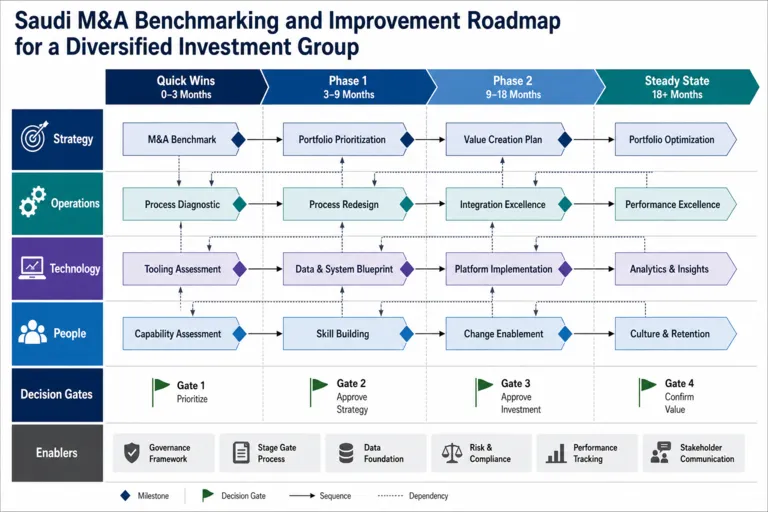
- Improvement roadmap development, proposing concrete initiatives, tools, and governance enhancements to bring the client’s M&A practice in line with leading standards.
Recommendations
Based on the benchmarking, we provided a prioritized set of improvement actions:
- Formalize a Saudi-specific M&A playbook, standardizing target screening criteria, due diligence requirements, valuation reviews, and integration planning steps.
- Introduce stage gates in the deal process, ensuring rigorous review of strategic fit, regulatory feasibility, and financial returns before progressing to advanced negotiations.
- Strengthen integration planning, starting earlier in the deal cycle and including clear synergy hypotheses, implementation workstreams, and leadership accountabilities.
- Implement a post-deal performance tracking system, monitoring revenue, margin, and synergy metrics against the original investment thesis over a multi-year period.
- Leverage external advisors selectively, particularly for complex regulatory or technical due diligence in sectors where internal expertise is limited.
- Build internal M&A capability, through training, centralized knowledge repositories, and cross-deal learning sessions focused on Saudi-specific insights and lessons learned.
Engagement ROI
The benchmarking engagement delivered tangible improvements in the client’s M&A discipline and performance potential. By tightening stage gates and decision criteria, the group reduced the number of low-probability or poorly aligned deals entering advanced evaluation stages, saving an estimated 20–25% of internal M&A effort that had previously been spent on ultimately abandoned opportunities. Enhanced integration planning and tracking practices were projected to increase synergy realization rates from approximately 55% to 70–75% on future Saudi deals. Standardizing valuation and due diligence practices helped reduce instances of post-deal underperformance, potentially protecting SAR 15–20 million in value per investment cycle. Overall, the benchmarking exercise repositioned the client to operate as a more consistent, data-driven, and Saudi-attuned acquirer across its M&A portfolio.
Talk to us for your needs in:
-
Due Diligence and Valuation Services
-
M&A Strategy and Advisory
-
Post-Merger Integration Management
-
Regulatory and Compliance Advisory
-
Market Entry and Expansion Consulting
-
Investment and Financial Analysis
-
In-Depth Market Survey for M&A
-
Market Intelligence and Insights in M&A
-
Feasibility Study and Assessment in M&A
-
Saudi M&A Benchmarking