

Issues
A technology-focused investor sought to build a long-term M&A pipeline in Saudi Arabia across software, digital infrastructure, and IT services. While they had conducted previous deals in other regions, they lacked robust market intelligence specific to the Saudi technology ecosystem. They required a continuous insights platform that would help them monitor emerging players, regulatory developments, funding trends, and potential acquisition opportunities, while ensuring that any M&A activity aligned with Saudi digitalization priorities and regulations.
Solution
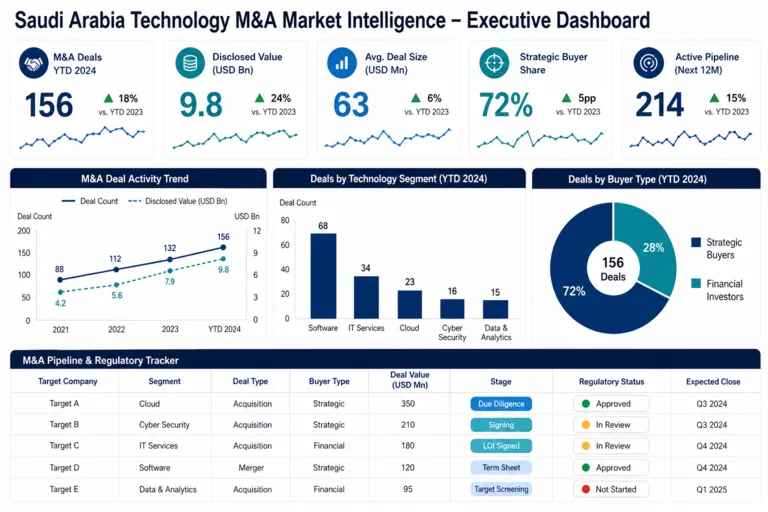
We built an ongoing market intelligence program tailored to M&A decision-making in Saudi Arabia’s technology sector. The solution combined systematic data gathering, competitive mapping, regulatory tracking, and deal opportunity screening. We developed dashboards and reports summarizing sub-sector growth, funding rounds, ecosystem developments, and policy changes that could impact valuations and risk profiles. The intelligence outputs were integrated into the client’s internal M&A evaluation process, providing a forward-looking view of where the most attractive opportunities were likely to emerge.
Approach
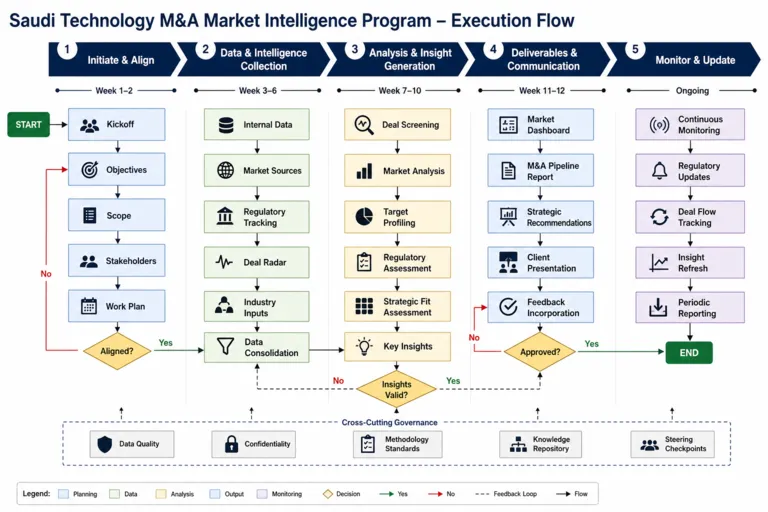
Our market intelligence approach was structured and repeatable:
- Ecosystem mapping, identifying key players across cloud services, enterprise software, fintech, cybersecurity, and digital infrastructure in Saudi Arabia.
- Data collection and enrichment, aggregating information from public disclosures, industry reports, events, startup databases, and direct outreach where appropriate.
- Regulatory intelligence, tracking updates from relevant Saudi authorities on data protection, cloud hosting requirements, and foreign ownership in technology-related entities.
- Competitive and partnership landscape analysis, reviewing alliances, joint ventures, and collaborations that might influence future deal-making dynamics.
- Opportunity radar creation, highlighting companies showing strong growth signals, customer traction, or strategic alignment with the client’s portfolio.
- Periodic insight reports and workshops, translating raw information into strategic implications for M&A pipeline building and prioritization.
Recommendations
We translated the intelligence into clear recommendations for the investor’s M&A strategy:
- Concentrate on sub-sectors benefiting directly from government digitalization programs, such as cloud infrastructure, digital identity, and cybersecurity services.
- Develop early relationship-building plans with high-potential technology firms, positioning the client as a preferred strategic investor when they consider raising capital or exploring exits.
- Incorporate regulatory scenario analysis into M&A evaluations, especially in areas like data residency and cross-border cloud services.
- Use market intelligence outputs to refine valuation assumptions, avoiding over-reliance on global multiples that may not reflect Saudi-specific dynamics.
- Segment the M&A pipeline by maturity stage, distinguishing between near-term acquisition candidates and longer-term options that require tracking and engagement.
- Create an internal M&A playbook informed by local intelligence, ensuring investment committees systematically consider Saudi-specific risks and opportunities in every decision.
Engagement ROI
The market intelligence program substantially increased the effectiveness and timing of the client’s M&A activities. By identifying emerging companies early, the investor gained access to proprietary deal flow, improving their likelihood of winning attractive transactions by an estimated 20–25% compared to reactive approaches. Calibrated valuation assumptions reduced the risk of overpayment and improved projected portfolio IRR by 3–5 percentage points across future deals. Regulatory intelligence helped avoid potential missteps that could have led to delays or restructuring costs worth SAR 5–8 million. Overall, the engagement transformed M&A from a reactive, opportunity-driven process into a proactive, insight-led strategy in the Saudi technology landscape.
Talk to us for your needs in:
-
Due Diligence and Valuation Services
-
M&A Strategy and Advisory
-
Post-Merger Integration Management
-
Regulatory and Compliance Advisory
-
Market Entry and Expansion Consulting
-
Investment and Financial Analysis
-
In-Depth Market Survey for M&A
-
Market Intelligence and Insights in M&A
-
Feasibility Study and Assessment in M&A
-
Saudi M&A Benchmarking