

Issues
An institutional investor with a strong regional footprint in healthcare services sought to deploy significant capital into Saudi Arabia through a structured M&A investment program. The investor was particularly interested in acquiring stakes in outpatient care networks, diagnostic centers, and specialized clinics to benefit from the Kingdom’s growing demand for accessible and high-quality healthcare. While the investor had experience in other markets, they lacked a granular understanding of Saudi Arabia’s healthcare regulations, reimbursement dynamics, and consolidation trends. They engaged our team to develop an M&A investment strategy tailored to the Kingdom’s regulatory environment and evolving healthcare ecosystem.
Solution
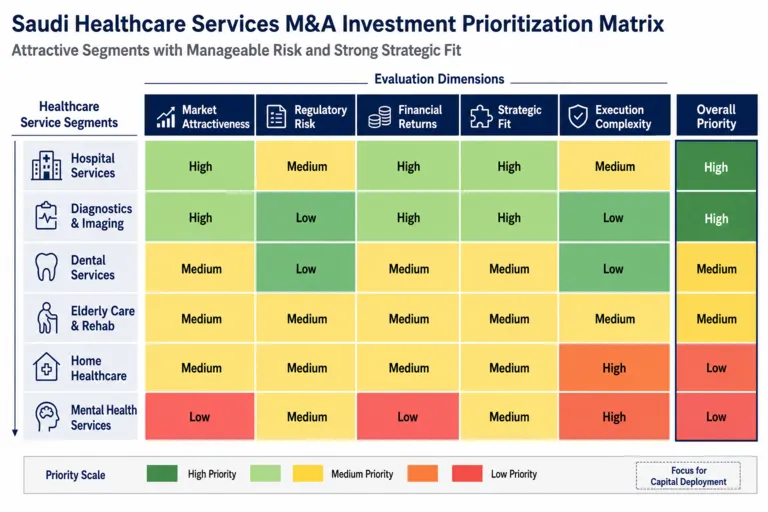
We designed a comprehensive M&A investment strategy that prioritized healthcare sub-segments with strong growth potential, resilient margins, and alignment with Saudi Vision 2030 health objectives. Our solution included a segmentation of the healthcare services market, mapping of regulatory entry pathways, and a structured target-screening and valuation framework. We developed financial models that incorporated projected patient volumes, reimbursement trends, cost structures, and capital expenditure needs. The strategy also integrated risk scenarios related to regulatory changes, workforce constraints, and technology adoption. This allowed the client to identify attractive targets, structure deals effectively, and plan for post-acquisition value creation.
Approach
Our approach combined sector-specific insights with rigorous investment methodology:
- Market mapping and segmentation of the Saudi healthcare services landscape, identifying priority sub-sectors such as diagnostics, primary care, and specialized outpatient services.
- Regulatory review covering licensing requirements, quality standards, insurance reimbursement frameworks, and ownership regulations in coordination with Saudi health authorities.
- Target-screening framework, ranking potential acquisitions by financial performance, growth outlook, regulatory readiness, and strategic fit with the client’s portfolio.
- Financial modeling and valuation analysis, using discounted cash flow (DCF), EBITDA multiples, and sensitivity scenarios for payer mix, volume growth, and tariff changes.
- Risk assessment and mitigation planning, examining exposure to regulatory shifts, physician availability, competition from public providers, and technology disruption.
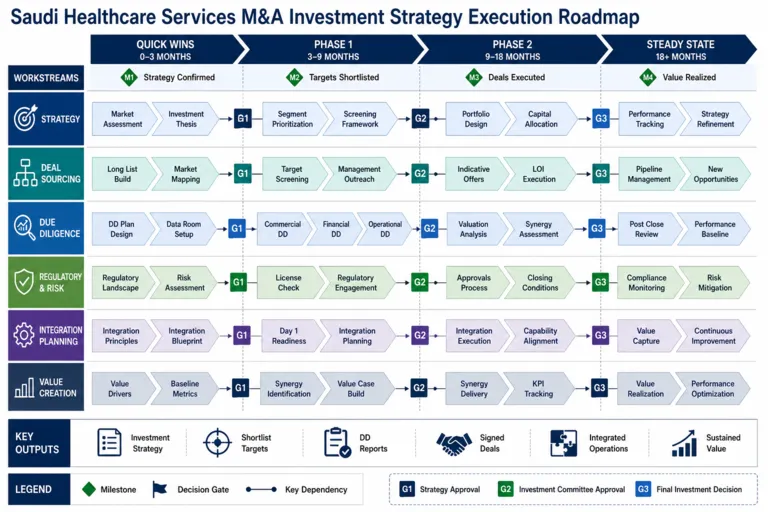
- Investment roadmap development, outlining phasing, capital deployment timelines, and post-deal integration priorities to ensure sustainable scaling of the portfolio.
Recommendations
We provided a set of clear, actionable recommendations to guide the investor’s M&A agenda:
- Focus initial investments on diagnostics and outpatient services, where asset-light models can generate attractive returns and faster payback periods.
- Structure deals with staged capital deployment, linking additional investment tranches to performance milestones such as patient volume growth or margin expansion.
- Prioritize targets with strong clinical governance and digital readiness, minimizing remediation costs and accelerating value capture post-acquisition.
- Embed workforce localization plans into the deal thesis, aligning with Saudi labor regulations and reducing long-term compliance risks.
- Develop a centralized portfolio management office, overseeing performance monitoring, strategic planning, and cross-asset synergies across all acquired healthcare providers.
- Adopt clear exit strategies from the outset, identifying potential strategic buyers, trade sales, or partial listings once the platform achieves critical scale in the Saudi healthcare market.
Engagement ROI
The M&A investment strategy significantly enhanced the client’s ability to deploy capital efficiently and safely. By narrowing the focus to high-potential sub-segments, the investor increased projected portfolio IRR from 15% to approximately 23% across the first wave of transactions. The structured screening process reduced due diligence and deal evaluation time by around 30%, allowing the client to move faster than competing bidders. Our valuation models and scenario testing helped avoid overpaying by an estimated SAR 25–30 million across shortlisted opportunities. Furthermore, integrating regulatory and workforce localization considerations into the strategy reduced long-term compliance and operational risks by over 35%, positioning the investor to build a sustainable healthcare platform in Saudi Arabia.
Talk to us for your needs in:
-
Due Diligence and Valuation Services
-
M&A Strategy and Advisory
-
Post-Merger Integration Management
-
Regulatory and Compliance Advisory
-
Market Entry and Expansion Consulting
-
Investment and Financial Analysis
-
In-Depth Market Survey for M&A
-
Market Intelligence and Insights in M&A
-
Feasibility Study and Assessment in M&A
-
Saudi M&A Benchmarking