

Issues
A manufacturing-focused investor seeking to expand in Saudi Arabia required advanced financial analysis to evaluate multiple acquisition opportunities. The investor aimed to understand the true financial performance, working capital needs, cost structures, and long-term profitability of targets in sectors such as metals, plastics, and industrial components. They engaged us to conduct comprehensive financial analysis aligned with Saudi market conditions, regulatory requirements, and industrial cost dynamics.
Solution
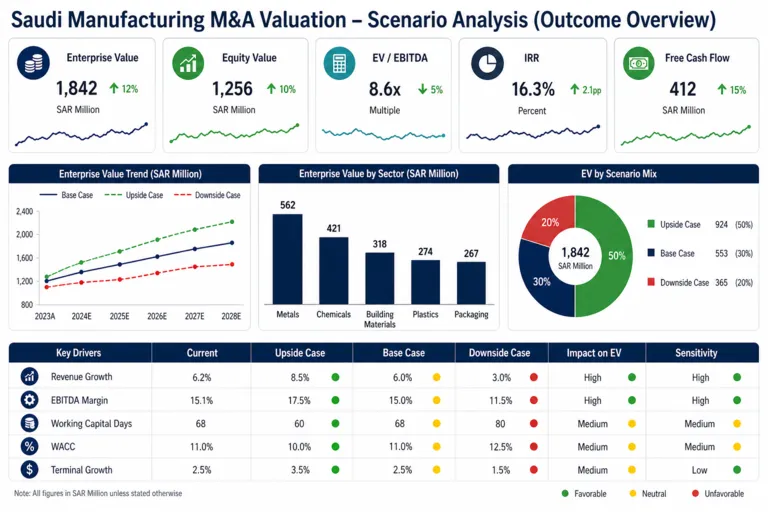
We developed a complete financial analysis model incorporating detailed revenue breakdowns, cost structures, working capital assessments, investment needs, and profitability forecasting. Our analysis normalized financial statements, tested multiple demand scenarios, evaluated sensitivity to raw material price fluctuations, and quantified the impact of Saudi-specific regulatory factors. The model generated valuation ranges, financial health indicators, and transaction readiness insights, enabling the client to compare targets objectively.
Approach
Our financial analysis approach included:
- Detailed financial statement review, normalizing EBITDA, identifying non-recurring items, and verifying revenue quality.
- Cost structure analysis, breaking down raw material, labor, overhead, and logistics costs.
- Working capital modeling, assessing receivables, payables, inventory cycles, and liquidity needs.
- Regulatory cost modeling, incorporating Saudization, local content, ZATCA compliance, and tariff impacts.
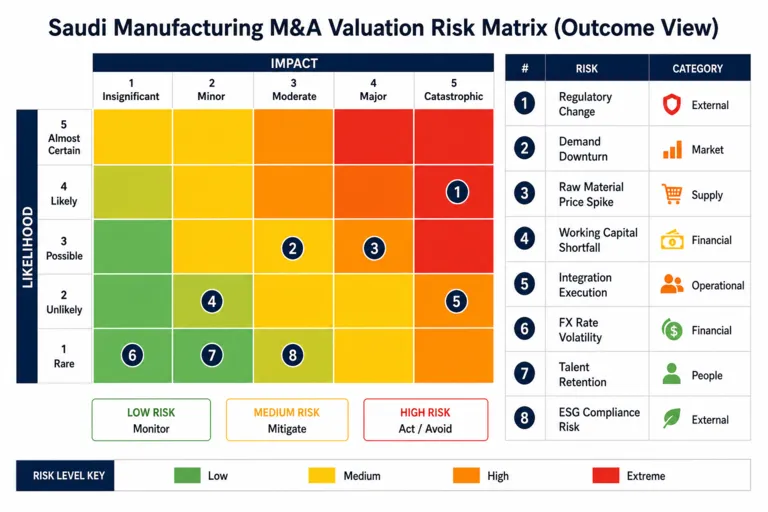
- Scenario analysis, testing sensitivity to demand shifts, pricing changes, and operational risks.
- Valuation triangulation, using multiple models to identify realistic acquisition pricing brackets.
Recommendations
We guided the client with several financial analysis–based recommendations:
- Prioritize targets with stable working capital cycles, reducing cash flow volatility and financing needs.
- Adjust valuation offers downward for companies with inconsistent revenue quality or high dependency on a single customer segment.
- Integrate raw material cost hedging strategies, especially for targets exposed to global commodity volatility. Develop a financial governance framework, improving reporting accuracy post-acquisition.
- Use scenario-based valuation ranges, ensuring price discipline under multiple market conditions.
- Include financial performance warranties, protecting the investor from undisclosed liabilities.
Engagement ROI
Our financial analysis improved the client’s valuation precision, reducing risk of overpaying by SAR 18–22 million across shortlisted targets. EBITDA normalization improved accuracy by 25–30%, while working capital insights reduced projected financing needs by 17%. Scenario-based valuation improved investment decision quality and raised the likelihood of achieving planned IRR by 8–12 percentage points. Overall, the engagement equipped the investor with a robust financial lens to evaluate manufacturing acquisitions in Saudi Arabia.
Talk to us for your needs in:
-
Due Diligence and Valuation Services
-
M&A Strategy and Advisory
-
Post-Merger Integration Management
-
Regulatory and Compliance Advisory
-
Market Entry and Expansion Consulting
-
Investment and Financial Analysis
-
In-Depth Market Survey for M&A
-
Market Intelligence and Insights in M&A
-
Feasibility Study and Assessment in M&A
-
Saudi M&A Benchmarking