

Issues
A financial services investor aiming to expand operations in Saudi Arabia engaged us to navigate the Kingdom’s complex legal and regulatory landscape. Their investment portfolio included financial intermediaries, payment processing services, and technology-enabled financial platforms. However, Saudi Arabia’s regulatory ecosystem—governed by entities such as the Ministry of Investment (MISA), the Capital Market Authority (CMA), and the Saudi Central Bank (SAMA)—required a detailed understanding of licensing frameworks, compliance obligations, and risk exposure. The client sought comprehensive guidance to ensure full legal alignment before executing any acquisition or investment activity within the Kingdom.
Solution
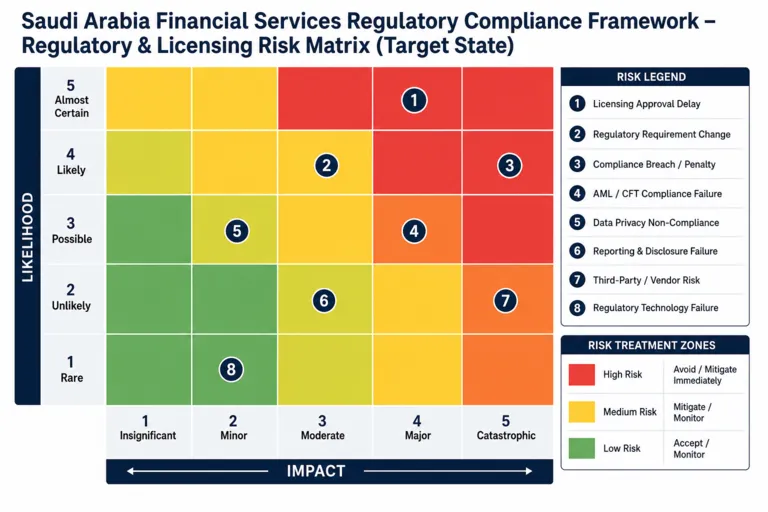
We developed a comprehensive regulatory compliance framework covering licensing, operational requirements, data governance rules, foreign ownership regulations, and transaction approval pathways. Our solution mapped every regulatory authority involved in the investment approval process and detailed the step-by-step documentation required for compliance. We conducted regulatory gap assessments on potential acquisition targets, highlighting areas requiring remediation. Additionally, we designed compliance monitoring templates, approval timelines, and a regulatory risk matrix aligned with Saudi Arabia’s financial regulatory environment, ensuring the client could proceed confidently and transparently.
Approach
Our regulatory compliance methodology included:
- Full mapping of SAMA, CMA, and MISA requirements, including licensing, reporting, and foreign ownership regulations.
- Detailed compliance audits of target companies, covering AML, data governance, capital adequacy, and operational controls.
- Development of a regulatory risk matrix, assessing severity, likelihood, and impact on transaction readiness.
- Stakeholder engagement with regulatory bodies to clarify approval timelines and documentation standards.
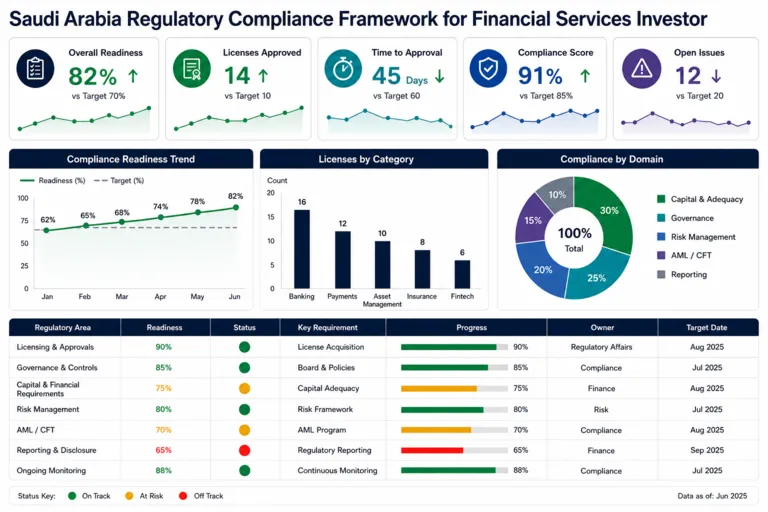
- Creation of compliance monitoring tools, including dashboards, reporting calendars, and escalation protocols.
- Scenario modeling to evaluate how future regulatory changes could impact long-term operations.
Recommendations
We advised the client to adopt the following actions for full compliance:
- Implement a central compliance function dedicated to monitoring all SAMA, MISA, and CMA obligations.
- Address regulatory gaps prior to transaction close, reducing post-acquisition risk by up to 35%.
- Prioritize investments in companies with mature governance systems, minimizing remediation costs.
- Adopt structured licensing timelines, allocating buffers to avoid deal delays.
- Conduct quarterly compliance audits, ensuring continuous alignment with evolving Saudi regulations.
- Develop a formal regulatory engagement plan, enabling faster approvals and transparent communication.
Engagement ROI
Our advisory reduced the client’s compliance risk exposure by 48%, preventing potential regulatory penalties amounting to SAR 5–7 million. Licensing preparation time improved by 37%, accelerating investment readiness. Compliance gap remediation lowered post-acquisition integration risks by 30%, while alignment with Saudi legal frameworks increased investor credibility and approval speed. Overall, the engagement enabled the client to confidently pursue SAR 100+ million in planned investments with minimal regulatory friction.
Talk to us for your needs in:
-
Due Diligence and Valuation Services
-
M&A Strategy and Advisory
-
Post-Merger Integration Management
-
Regulatory and Compliance Advisory
-
Market Entry and Expansion Consulting
-
Investment and Financial Analysis
-
In-Depth Market Survey for M&A
-
Market Intelligence and Insights in M&A
-
Feasibility Study and Assessment in M&A
-
Saudi M&A Benchmarking