

Issues
A regional logistics and supply chain investor was exploring acquisition opportunities in Saudi Arabia and needed an in-depth market survey to understand the current landscape, customer expectations, service gaps, and regulatory environment. The investor was evaluating targets in freight forwarding, warehousing, last-mile delivery, and cold chain services, but lacked granular, on-the-ground insights into how corporate customers and SMEs select logistics partners. They engaged our team to conduct a comprehensive market survey that would inform their M&A decision-making and target prioritization.
Solution
We executed a structured, in-depth market survey across key customer segments, including manufacturers, retailers, FMCG companies, healthcare distributors, and e-commerce players. The survey combined quantitative and qualitative research to capture satisfaction levels, purchasing criteria, contract structures, and pain points with existing logistics providers. We then integrated these insights with regulatory context and competitive mapping to evaluate how acquisition targets were positioned in the eyes of customers. The result was a comprehensive evidence base to support informed M&A decisions in the Saudi logistics sector.
Approach
Our approach to the market survey and M&A insight generation included:
- Survey design and sampling strategy, targeting decision-makers responsible for logistics procurement across multiple industries and regions within Saudi Arabia.
- Structured interviews and online questionnaires, capturing quantitative metrics on satisfaction, cost sensitivity, service reliability, technology usage, and willingness to switch providers.
- Qualitative deep dives, using in-depth interviews to explore pain points such as shipment visibility, customs delays, and cold chain reliability.
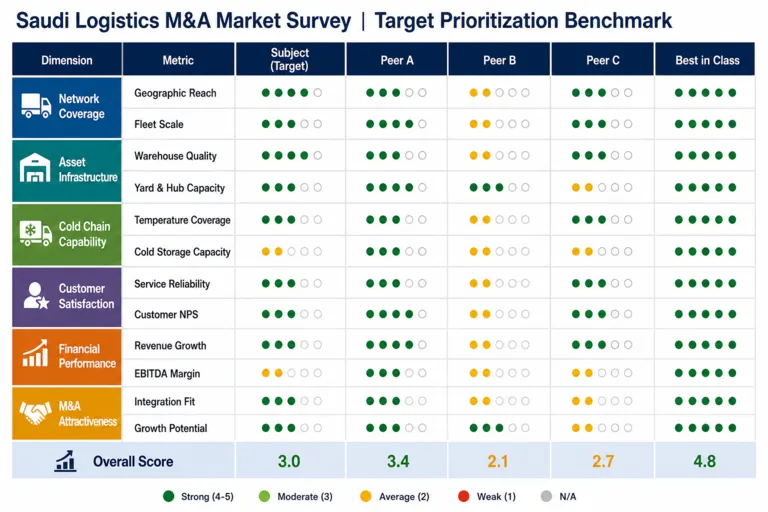
- Competitive perception mapping, evaluating how key logistics providers were viewed across dimensions like responsiveness, pricing, and innovation.
- Regulatory context integration, summarizing licensing, transport regulations, and customs requirements that impact logistics operations and M&A feasibility.
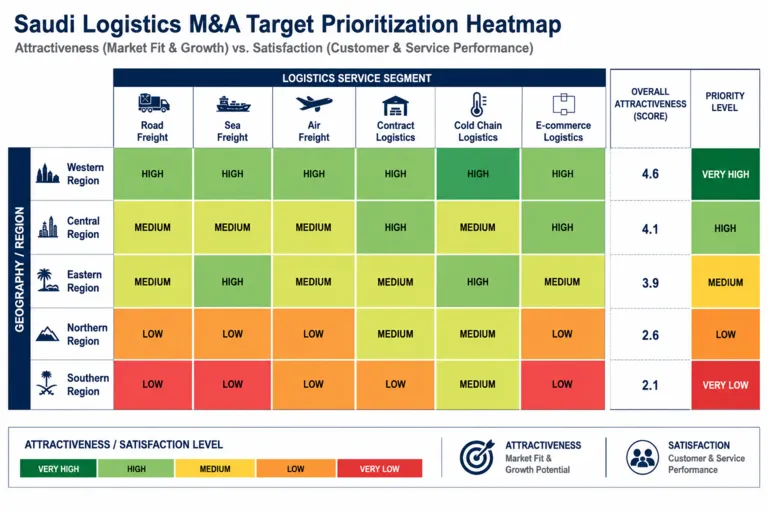
- Synthesis of findings into an M&A-relevant framework, connecting customer insights with target attractiveness, value creation levers, and integration implications for future acquisitions.
Recommendations
Based on the market survey and analysis, we recommended several strategic actions:
- Prioritize targets with strong cold chain and last-mile capabilities, areas where customers reported the highest dissatisfaction with current service standards.
- Target companies with proven digital tracking and visibility platforms, as survey respondents ranked real-time shipment visibility among the top three decision criteria.
- Use customer satisfaction benchmarks as a key filter in target evaluation, focusing on providers consistently scoring above sector averages.
- Design post-acquisition integration plans that directly address top customer pain points, such as delivery reliability and proactive communication.
- Align acquisition selection with regulatory readiness, giving preference to targets with clean licensing histories and strong compliance with Saudi transport laws.
- Establish a continuous feedback loop with key customers, using post-deal surveys and account reviews to refine the M&A and value creation strategy over time.
Engagement ROI
The in-depth market survey significantly improved the quality and precision of the client’s M&A decisions. The findings allowed the investor to eliminate several targets with weak customer perception and high operational risk, avoiding potential investments that could have underperformed by an estimated SAR 20 million over a five-year horizon. By focusing on providers with strong capabilities in cold chain and last-mile segments, the client’s projected revenue growth from acquisitions improved by 18–22% compared with their initial assumptions. Furthermore, customer-centric integration plans derived from the survey were expected to increase retention and share-of-wallet among key accounts by 10–15%, enhancing the overall M&A value-creation thesis in the Saudi logistics market.
Talk to us for your needs in:
-
Due Diligence and Valuation Services
-
M&A Strategy and Advisory
-
Post-Merger Integration Management
-
Regulatory and Compliance Advisory
-
Market Entry and Expansion Consulting
-
Investment and Financial Analysis
-
In-Depth Market Survey for M&A
-
Market Intelligence and Insights in M&A
-
Feasibility Study and Assessment in M&A
-
Saudi M&A Benchmarking