

Issues
An international investor specializing in renewable energy was considering acquiring or partnering with Saudi-based companies in solar and wind project development, EPC services, and operations and maintenance. Before committing capital, the investor needed a detailed feasibility study to assess whether M&A was the right entry route, which segments held the greatest potential, and how regulatory frameworks and energy transition policies would affect long-term returns. Our team was engaged to conduct a feasibility assessment that would validate the attractiveness and practicality of M&A-led entry into the Saudi renewable energy market.
Solution
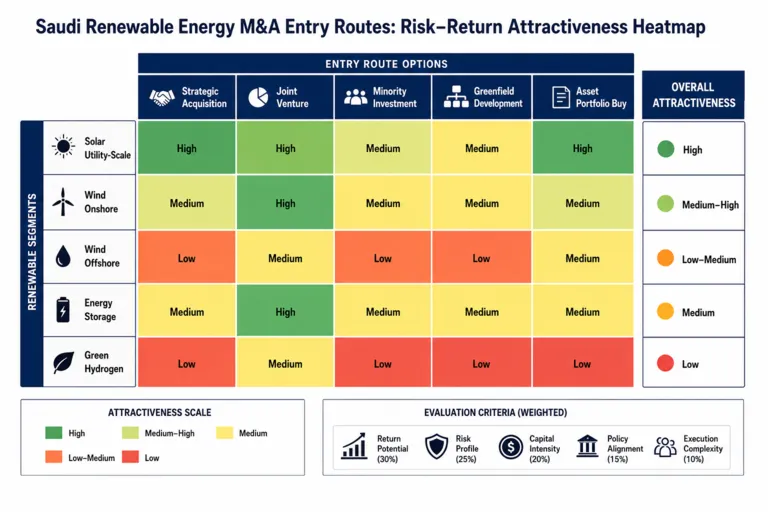
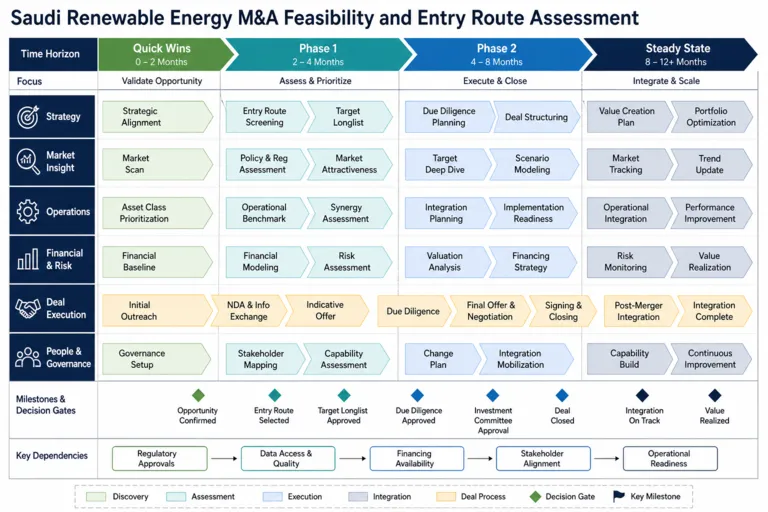
We developed a feasibility study and M&A assessment that evaluated entry routes, target segments, regulatory feasibility, financial potential, and risk factors. The solution included a thorough review of Saudi renewable energy policies, tender frameworks, and incentives; a mapping of existing project pipelines and players; and financial modeling across multiple entry scenarios. We compared M&A-driven entry with alternative approaches such as greenfield development or joint ventures, quantifying the advantages and challenges associated with each. The assessment produced a clear recommendation on whether, where, and how to pursue M&A in the Saudi renewable energy space.
Approach
Our feasibility and assessment approach included several structured components:
- Policy and regulatory review, analyzing renewable energy targets, procurement frameworks, tariff structures, and local content expectations that shape market entry conditions for investors.
- Market sizing and segmentation, estimating potential capacity additions, revenue pools, and growth trajectories across solar, wind, and related service segments.
- Competitive landscape analysis, profiling local and regional players active in development, EPC, and operations and maintenance, along with their project track records and partnerships.
- Scenario-based financial modeling, comparing M&A acquisitions, JV formations, and greenfield entry in terms of capital requirements, payback periods, and risk-adjusted returns.
- Risk assessment, addressing policy continuity, grid integration challenges, permitting bottlenecks, and technology cost evolution.
- Feasibility scoring, ranking each route and segment based on strategic fit, feasibility, and value-creation potential for the investor.
Recommendations
The feasibility study led to a set of concrete recommendations for the client’s M&A decision:
- Pursue targeted M&A in project development and operations and maintenance, where local knowledge and execution capabilities are critical and difficult to build from scratch.
- Avoid large, highly-leveraged EPC acquisitions, which carry higher risk exposure to cost overruns and procurement volatility.
- Use joint ventures as an intermediate step, combining local partners’ regulatory and land-access expertise with the client’s technical and financial strengths.
- Align M&A timing with upcoming tender rounds and policy milestones, ensuring that acquired entities can benefit from pipeline visibility.
- Integrate feasibility criteria into M&A target screening, such as project track record, strength of offtake arrangements, and capability to meet local content requirements.
- Develop a staged capital deployment plan, starting with smaller deals to build local presence and knowledge before expanding into larger transactions.
Engagement ROI
The feasibility assessment helped the investor avoid premature or misaligned acquisitions that could have tied up SAR 80–100 million in suboptimal assets. By recommending a focused M&A route centered on project development and operations and maintenance, the study improved projected portfolio IRR from around 12% to 19–20% in the recommended scenarios. Scenario comparisons showed that certain acquisition paths carried significantly higher regulatory and execution risks; steering away from those options reduced downside exposure by an estimated 30–35%. The clarity provided by the feasibility assessment also shortened internal decision cycles, enabling the investor to align investment committees around a coherent, Saudi-specific M&A strategy in the renewable energy sector.
Talk to us for your needs in:
-
Due Diligence and Valuation Services
-
M&A Strategy and Advisory
-
Post-Merger Integration Management
-
Regulatory and Compliance Advisory
-
Market Entry and Expansion Consulting
-
Investment and Financial Analysis
-
In-Depth Market Survey for M&A
-
Market Intelligence and Insights in M&A
-
Feasibility Study and Assessment in M&A
-
Saudi M&A Benchmarking