

Issues
A major investor in the manufacturing industry sought to enter Saudi Arabia’s rapidly growing industrial ecosystem, particularly segments supported by Vision 2030 localization programs. The client faced increasing competitive pressure from regional players and required a corporate finance advisory engagement to evaluate capital structure, optimize investment allocation, and understand funding pathways aligned with Saudi industrial policies. The organization lacked the internal financial modeling capabilities needed to assess long-term returns, balance sheet impact, and liquidity risks, especially in a market undergoing regulatory shifts driven by initiatives from entities such as the Ministry of Industry and Mineral Resources and the National Industrial Development and Logistics Program (NIDLP). Our team was engaged to provide a structured corporate finance roadmap anchored in Saudi market realities.
Solution
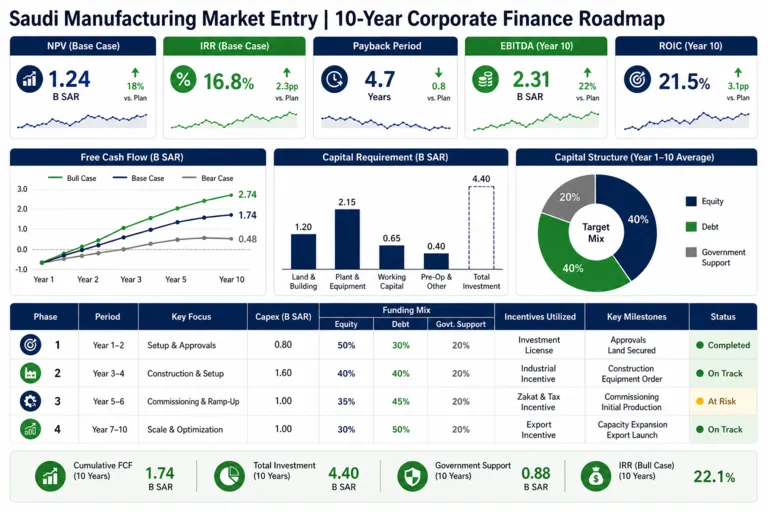
We delivered a comprehensive corporate finance framework tailored to Saudi Arabia’s industrial regulatory environment. The solution included a full capital structure assessment, stress testing under multiple economic scenarios, and a funding strategy aligned with the client’s long-term expansion goals. We incorporated Saudi-specific policies—such as local content requirements, financing incentives, and industrial cluster regulations—into our analysis to ensure accurate risk modeling. The financial models included 10-year projections with IRR, NPV, WACC, debt-service coverage ratios, and liquidity tracking. We identified opportunities to leverage government financial support structures, optimize borrowing costs, and reduce capital inefficiencies. Our solution positioned the client to confidently pursue their growth initiatives with a financially resilient and regulatory-compliant structure.
Approach
Our methodology combined Saudi regulatory review, advanced corporate finance analysis, and scenario-based modeling. Key activities included:
- Mapping of the Saudi regulatory financing landscape, covering incentives from SIDF, NIDLP, and local content requirements.
- Building integrated financial models projecting cash flows, capital needs, EBITDA trends, and valuation ranges.
- Conducting debt capacity assessments to evaluate leverage, repayment capability, and long-term capital constraints.
- Benchmarking financing structures of comparable entities operating in Saudi industrial sectors. Engaging stakeholders to validate assumptions for pricing, demand, cost escalations, and risk drivers.
- Testing alternative investment pathways, including acquisitions, JV partnerships, and phased greenfield projects.
Recommendations
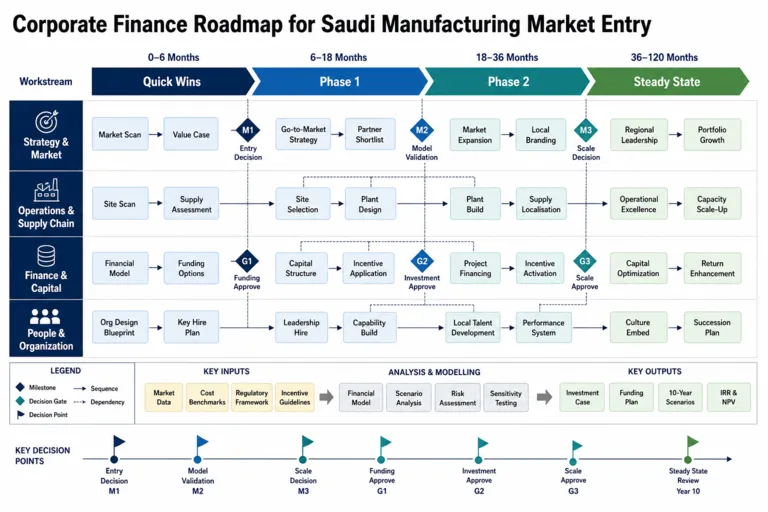
We proposed a strategic finance roadmap aligned with expected market shifts. Key recommendations included:
- Adopt a balanced capital structure with a debt-to-equity ratio optimized for SIDF financing compliance.
- Utilize government-backed incentives to reduce financing costs by an estimated 12–18% over the investment cycle.
- Pursue a phased investment strategy, beginning with a minority acquisition to reduce upfront risk. Strengthen financial governance, including quarterly stress testing and liquidity reviews.
- Develop an internal financial planning function to enhance capital budgeting and long-term scenario planning.
- Integrate valuation review checkpoints to dynamically adjust strategy based on economic shifts.
Engagement ROI
Our corporate finance advisory delivered measurable value for the client. The optimized financial structure reduced expected borrowing costs by SAR 18–22 million over seven years, while improving the projected IRR of the planned investment from 11% to 17%. Scenario testing reduced capital risk exposure by approximately 28%, and the proposed phased investment lowered initial capital outlay by 35%, enhancing financial agility. Access to Saudi government incentives further improved cash flow stability, enabling the client to accelerate expansion by nearly two years. Overall, the engagement positioned the organization to confidently deploy over SAR 120 million in planned investments with a clearer understanding of financial sustainability, regulatory alignment, and risk-adjusted value creation.
Talk to us for your needs in:
-
Due Diligence and Valuation Services
-
M&A Strategy and Advisory
-
Post-Merger Integration Management
-
Regulatory and Compliance Advisory
-
Market Entry and Expansion Consulting
-
Investment and Financial Analysis
-
In-Depth Market Survey for M&A
-
Market Intelligence and Insights in M&A
-
Feasibility Study and Assessment in M&A
-
Saudi M&A Benchmarking